
Case study · New build · UK
SEO built in before launch. Here’s how far that got us, and where it stopped.
Most of my work is cleaning up after someone else. This one was different: a brand-new domain, and I was in from the start.
~60
Organic clicks a day by July
~5
Calls a day from organic
~2
Forms a day from organic
298k
Impressions in 6 months
| Client | UK-based business |
| Starting point | New domain. No history, no backlinks, no rankings |
| My role | Technical SEO from development, through launch, into the first 6 months |
| Launch | Late April 2026 |
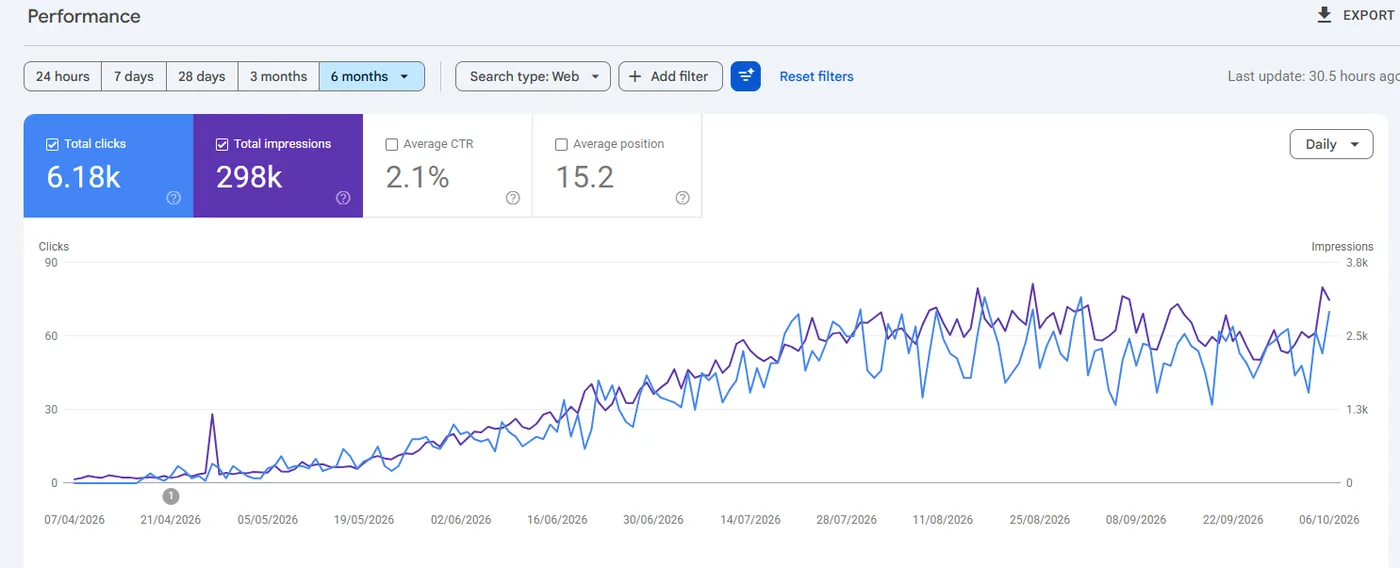
| First 6 months | 6,180 organic clicks, 298,000 impressions. Avg CTR 2.1%, avg position 15.2 |
| By July | ~60 organic clicks, ~5 phone calls and ~2 contact forms a day. All from organic search |
| The honest bit | Growth has been flat since late July |
The starting point
Most technical SEO is repair work. Redirect chains. Orphaned pages. A staging site Google found before the client did. All of it comes from builds where SEO turned up after launch.
This project was the opposite. New domain, nothing to inherit, and I was involved while the site was being built. The job wasn’t to fix anything. It was to make sure there’d be nothing to fix.
What went in before launch
- URLs that match how people search. People in this market search by product type, by material and by location. So that’s how the site is structured. Every page has a real search behind it.
- Staging behind a password. Not a noindex tag. Noindex on staging is a classic way to wreck a launch: it gets copied to live with the rest of the database. A password can’t be carried over by accident, and Google can’t crawl what it can’t reach.
- A launch checklist with names on it. robots.txt swap, noindex removal, sitemap submission, canonicals. Each one a step, each one signed off. Not “we’ll sort it on the day”.
- Templated titles and H1s. Every page type gets a pattern that produces unique, descriptive titles. Duplicates don’t creep in when page 200 goes up.
- Schema from day one. LocalBusiness/Organization for the company, Product/Service for the core offerings.
- Fast pages, even the heavy ones. This business sells on photos, so the gallery and project pages were always going to be the slowest on the site. Image weight was kept in check, so they pass Core Web Vitals without losing the photos that actually sell.
Launch
Google found the site quickly. In late April, impressions spiked for a single day, then settled. That’s most likely Google trying a new site on broad queries to see where it fits. It brought almost no clicks. I didn’t count it as a result, and neither should you.
The climb: May to July
Over about 13 weeks, daily clicks went from single figures to around 60. Almost a straight line. No post-launch dip, no lost weeks.
Clicks rose in step with impressions. So the pages weren’t just being shown, they were being clicked. The titles and targeting were doing their job.
By July, organic search alone was bringing in about 5 phone calls and 2 contact forms a day. Roughly one enquiry for every 8–9 clicks, from a domain that didn’t exist three months earlier.
A clean technical setup doesn’t create demand. It just stops a new site wasting its first months on problems it caused itself.
The plateau: late July onwards
Then it flattened. Since late July the site has sat at roughly 2,500–3,300 impressions and 35–75 clicks a day.
The honest bit
My read: this is about as far as technical SEO alone takes a new domain in a competitive local market. The site is crawlable, indexed, fast and properly structured. What it doesn’t have yet is authority. An average position of 15.2 means a lot of its visibility sits on page 2, and nobody clicks on page 2. More technical work won’t fix that. Content and links will.
What I’d do differently
Start content production and link building at launch, alongside the technical work, rather than after the climb levelled off.
What’s next
The technical side is now maintenance. Next up: content that answers what buyers ask before they pick up the phone, and links to the core product and location pages. The goal is simple. Get the page-2 queries onto page 1.
FAQ
Questions about this case study
When should SEO get involved in a new website build?
Before the first template is built. URL structure, page templates, titles, schema and staging setup are all decided during development, and every one of them is cheaper to get right then than to fix after launch. On this project I was involved from the start, so there was nothing to clean up afterwards.
Why password-protect a staging site instead of using a noindex tag?
Because a noindex tag lives in the database and can be copied to the live site along with everything else. That is one of the most common ways launches go wrong. A password can’t be carried over by accident, and Google can’t crawl a site it can’t reach.
How long does a new domain take to get organic traffic?
It depends on the market and the competition, so there is no fixed answer. Here, a brand-new domain went from zero to around 60 organic clicks a day in about 13 weeks, and was bringing in roughly 5 phone calls a day from organic search by July. A clean launch doesn’t guarantee that pace; it just stops the site losing its first months to its own mistakes.
Why did organic traffic stop growing after a few months?
Because technical SEO only takes a new site so far. Once the site is crawlable, indexed, fast and properly structured, further growth depends on authority: content and links. With an average position of 15.2, a lot of this site’s visibility was on page 2, and that is not a technical problem.
Is technical SEO enough on its own for a new website?
No. It is the foundation, not the whole house. It makes sure nothing gets in the way, but it doesn’t create demand or authority. Looking back, I’d start content production and link building at launch, alongside the technical work.
More case studies
Two more, same honesty.
Migration · UK
+39%
organic clicks a day, first 6 weeks after the move
Off Lovable without losing a click
An AI-built site moved to WordPress. URLs kept, no dip on launch day, traffic up.
Audit & maintenance · Shopify
+53%
organic search revenue, year one vs the year before
A year of technical SEO on Shopify
Broken links, thousands of 404s and category pages sending Google mixed signals. Fixed.
New site on the way?
Get SEO in before launch, not after. It’s the cheapest SEO you’ll ever buy.