
Case study · Technical audit & maintenance · Shopify · UK
A year of technical SEO on a Shopify store. What it earned, and what it didn’t.
No migration, no redesign. Just finding what was quietly broken, fixing it, and keeping it fixed. Then checking whether any of it turned into money.
+53%
Organic search revenue
£222k
Organic revenue, year one
10/12
Months up year on year
+29%
Clicks a day, Sept vs Sept
| Client | UK retailer |
| Platform | Shopify |
| The job | Technical audit, then ongoing technical maintenance |
| Started | 1 October 2025 |
| Year one | Organic search revenue £222k, up from £145k. Whole store, all channels: up 38% |
| The honest bit | Organic is about 4% of the store’s revenue. Paid ads run this business |
What I found
Nothing dramatic. That’s usually how it goes with established stores. No single disaster, just a lot of small leaks.
- A couple of hundred broken internal links. Old products, renamed collections, links nobody updated. Each one a dead end for customers and for Googlebot.
- A couple of thousand 404s in Search Console. Google was still trying URLs that no longer existed and spending crawl on pages that would never rank.
- Category pages linking to the wrong product URLs. A classic Shopify quirk. Product links inside collections pointed to versions of the URL that were canonicalised elsewhere. So every category page told Google “this product lives here”, and every product page replied “no, it doesn’t”. Mixed signals, across the whole catalogue.
What was fixed
- Broken links: fixed. All of them, then checked again as part of ongoing maintenance, because they come back every time products change.
- 404s: cleaned up. The couple of thousand Search Console errors were worked through, so Google stopped chasing dead URLs.
- Category links: pointed at the indexable product URLs. Live on 3 January 2026. Now the category pages and the product pages say the same thing.
What happened to traffic
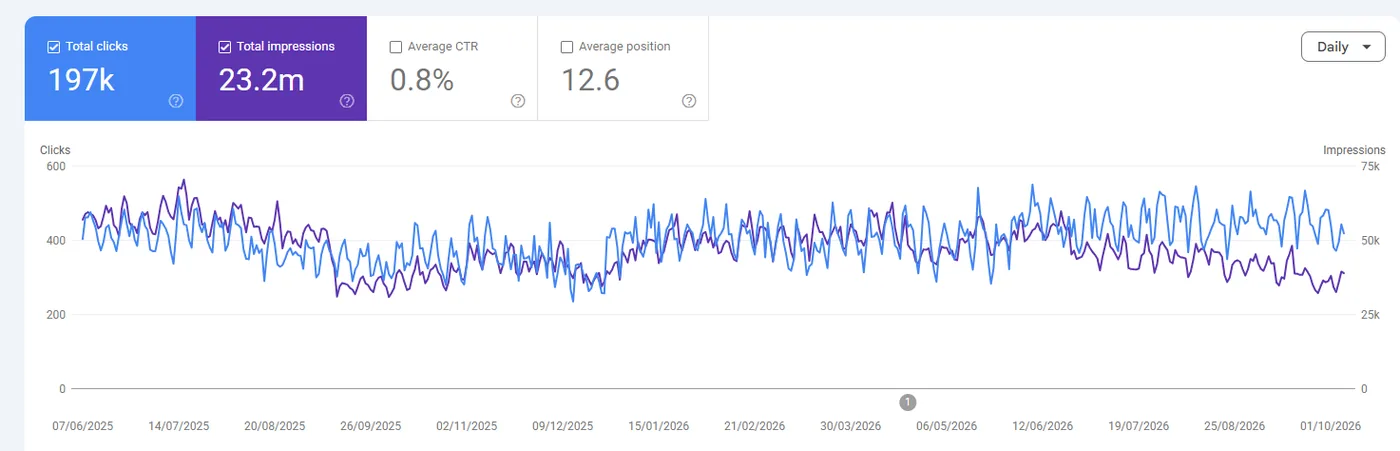
Gym equipment is seasonal. January is huge, summer is quiet, autumn slides. So the only fair comparison is year on year, month against the same month.
| Organic clicks a day | 2025 | 2026 | Change |
|---|---|---|---|
| July | 425 | 449 | +6% |
| August | 379 | 450 | +19% |
| September | 354 | 458 | +29% |
| October (1st–6th) | 326 | 409 | +25% |
The gap gets wider every month. CTR over the summer went from 0.74% to 1.01%: fewer wasted impressions, more clicks per appearance. Only about 16% of clicks are people searching the brand name, so this is real non-brand traffic.
What happened to revenue
Traffic is nice. Revenue pays the invoice. So I pulled sales from Shopify, filtered to organic search only. Not “search”, which included Google Ads. Organic.
| Organic search revenue | Year before | Year one | Change |
|---|---|---|---|
| Oct–Jan | £48.2k | £92.7k | +92% |
| Feb–May | £32.0k | £59.3k | +85% |
| Jun–Sep | £60.3k | £66.6k | +10% |
| Oct 1st–10th, year two | £4.6k | £3.3k | early days |
| Total | £145.3k | £222.0k | +53% |
Ten of twelve months were up on the year before. For context, the whole store grew 38% across all channels in the same period. Organic grew faster.
The honest bits
Organic is a small slice. About 4% of the store’s revenue. Paid ads drive this business, and SEO isn’t about to change that. +53% on a small slice is still a small slice.
I can’t show the canonical fix in the click data. Clicks jumped on Boxing Day, eight days before the fix went live. That’s the New Year fitness rush, not me. The fix was the right thing to do, but I won’t pretend a graph proves it.
Monthly revenue is noisy. At £3k to £30k a month, a couple of big equipment orders swing a month either way. August is down 46%, because August last year had a big sale. The full-year figure is the one to trust.
Ignore the average position. It went from 18.5 to 10 in the data. Most of that is Google switching off 100-results pages in September 2025, which wiped rank-tracker impressions for everyone. It’s a reporting change, not a ranking gain.
Takeaway for Shopify store owners
Check where your collection pages link to. If product links inside collections point to a URL that’s canonicalised somewhere else, your own theme is sending Google mixed signals on every category page. It’s a quiet problem, it’s common, and it’s cheap to fix.
FAQ
Questions about this case study
Why do Shopify collection pages link to non-canonical product URLs?
Many Shopify themes link to products through their collection, so the link points to a collection-specific version of the product URL. Shopify canonicalises that version to the main product URL. The result is every category page telling Google one address while the product page claims another. In themes that do this, the cause is usually the within: collection filter on product links in the collection template.
Should I fix every 404 error in Google Search Console?
No. A 404 for a page that is genuinely gone and has no links or traffic is fine. The ones worth fixing are URLs your own site still links to, URLs with backlinks, and URLs that have a clear replacement. On this store, a couple of hundred broken internal links and a couple of thousand 404s in Search Console were worked through.
How do you measure organic search revenue in Shopify?
With a ShopifyQL report in Analytics, filtered on order referrer source = ‘search’ AND traffic type = ‘organic’, grouped by month and compared to the previous year. Filtering on ‘search’ alone is a trap: on this store it included Google Ads and showed about £1.1m instead of the real organic figure of £222k.
Why did average position improve so much in Search Console?
Mostly because of a reporting change, not rankings. In September 2025 Google stopped serving 100 results per page, which removed a lot of rank-tracker impressions from deep positions for every site. Average position jumped from about 18.5 to 10 on this store as a result. Clicks and revenue are the numbers to trust.
Does technical SEO increase revenue?
It can. On this store, organic search revenue grew 53% in the first year, faster than the store as a whole. But organic is about 4% of its revenue, monthly figures swing with large orders, and some fixes, like the canonical change, can’t be isolated in the data. Technical SEO removes what holds a site back; it isn’t a revenue switch.
More case studies
Two more, same honesty.
New build · UK
~5 calls/day
from organic search, three months after launch
SEO built in before launch
A brand-new domain, set up right from day one. Zero to ~60 organic clicks a day in 13 weeks.
Migration · UK
+39%
organic clicks a day, first 6 weeks after the move
Off Lovable without losing a click
An AI-built site moved to WordPress. URLs kept, no dip on launch day, traffic up.
Running a Shopify store?
I’ll tell you what’s quietly leaking, and what’s worth fixing first.