
Case study · Rebuild · Strapi and Next.js → WordPress · Education · UK
Fast, but nobody could edit it. A Next.js site rebuilt in WordPress.
This one wasn’t slow. It was built for speed, on a modern headless stack. The problem was that nobody could edit it without a developer. So it moved to good old WordPress, and got a little faster on the way.
98
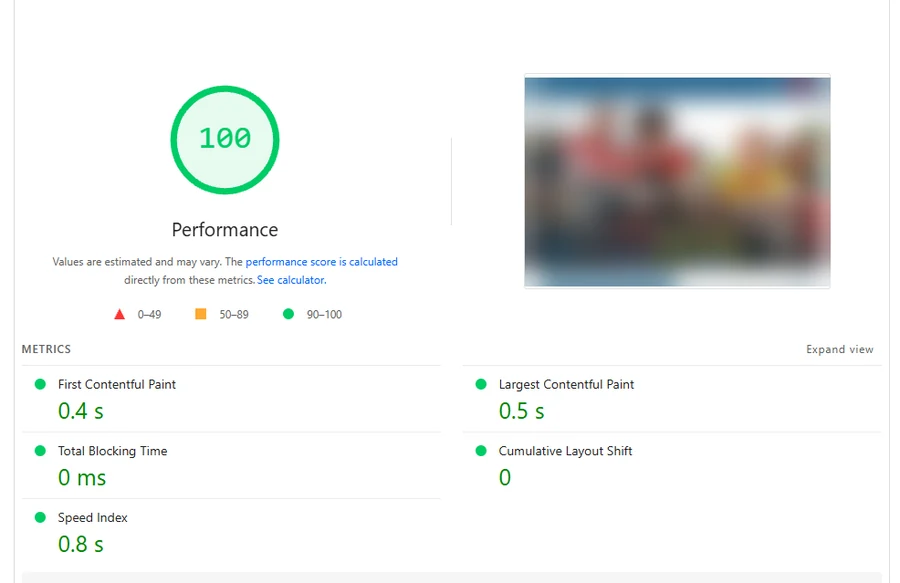
Mobile PageSpeed (was 94)
100
Desktop PageSpeed (was 95)
3
Active plugins
| Client | UK education website |
| Platform | Strapi and Next.js → WordPress |
| The job | One-to-one rebuild: same layout, same features |
| Live | 31 October 2026 |
| Before | Fast, but no usable backend. Every content change was a developer job |
| After | 3 active plugins in total, no caching plugin needed. Every page editable in WordPress itself |
| The honest bit | The old site was already fast. Speed was never the problem here |
The starting point
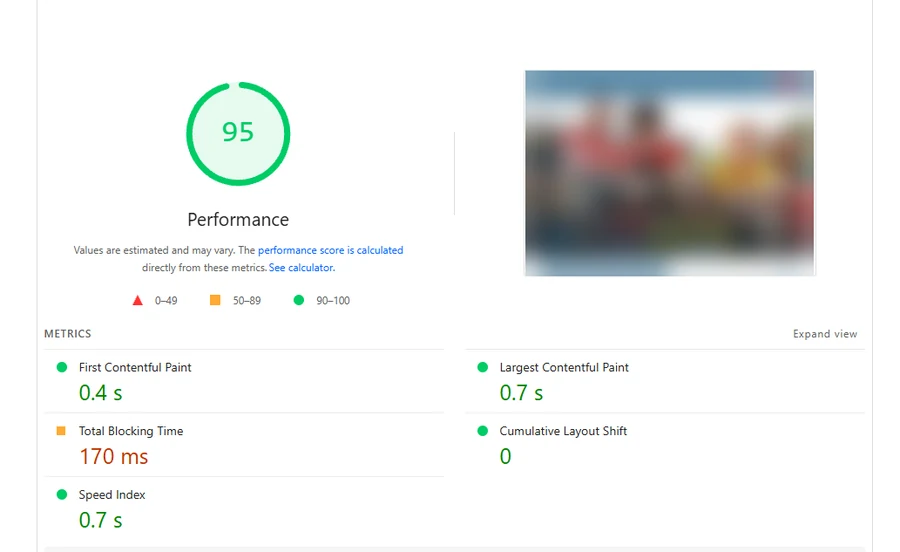
A headless setup: content in Strapi, the front end in Next.js. Technically modern and genuinely quick, 94 on mobile PageSpeed.
But for the people running it, editing was impossible. New page, new photo, fixed typo: every change went to a developer and waited in a queue. A website that can’t be updated slowly goes out of date, and no amount of speed fixes that.
What was rebuilt
- One to one. Same layout, same pages, same features, now in WordPress.
- 3 active plugins, and that’s all of them. No caching plugin needed.
- Fully editable. The team, me, or any other developer can change anything.
Structured data, from nothing
The old site had none. Now it has:
- EducationalOrganization: name, URL, logo, description, email, phone, correspondence address, and Facebook, Instagram, X and YouTube profiles
- Course on the homepage
- Article on all 19 news articles: headline, description, image, published and modified dates, author, and the organisation as publisher
- FAQPage with 13 questions and answers
- AboutPage on the 6 About pages, ContactPage, CollectionPage on 5 listing pages, WebPage on everything else
- WebSite and Place
The numbers
| PageSpeed Insights (lab) | Before | After |
|---|---|---|
| Mobile | 94 | 98 |
| Desktop | 95 | 100 |
| Active plugins* | n/a (Strapi + Next.js) | 3 |
*All active plugins. No caching plugin is installed: the scores come from the build itself.
The honest bits
The win isn’t speed. 94 to 98 on mobile is a small step, within the range lab scores move between runs. The real result is that the site can be edited again. That it didn’t get slower, and actually got a bit faster, is the bonus.
These are lab scores from PageSpeed Insights, not real-user data.
Headless isn’t wrong. For a large team with developers on hand it can be the right call. For a site run by a small team that needs to publish, it was the wrong tool.
Takeaway
Pick the stack for the people who’ll run the site, not for the benchmark. A fast site nobody can update loses to a fast site that gets updated every week.
FAQ
Questions about this case study
Is a headless Next.js site better for SEO than WordPress?
It can be fast, and this one was: 94 on mobile PageSpeed. But speed is only part of SEO. If every content change needs a developer, content stops getting updated, and that costs more than a few points of PageSpeed. Rebuilt in WordPress, this site is now editable by anyone and scores 98 on mobile.
Can WordPress be as fast as a Next.js site?
Yes, if it’s built with care. A clean block theme, a short plugin list and properly sized images go a long way. This rebuild runs on 3 plugins in total, with no caching plugin, and scores 98 on mobile and 100 on desktop, slightly higher than the Next.js original.
Why move from Strapi to WordPress?
Because the people running the site couldn’t use it. Every change was a developer job. WordPress gives editors a familiar backend, previews and revisions out of the box, and any WordPress developer can pick it up.
What structured data does an education website need?
An EducationalOrganization entity with contact details and social profiles is the foundation. On top of that this site has Course markup, Article markup on all 19 news articles, a FAQPage with 13 questions, and the right page types for About, Contact and listing pages. Before the rebuild it had none.
More rebuilds
Two more, same approach.
Rebuild · WP → WP
97
mobile PageSpeed after the rebuild, up from 47
Hacked through an outdated plugin
Hacked through an outdated paid plugin and slow on mobile. Same site, rebuilt on 8 plugins.
The win: Mobile PageSpeed 47 → 97, and the plugin that let the hackers in is gone for good.
Rebuild · WP → WP
95
mobile PageSpeed after the rebuild, up from 37
Off Elementor, onto blocks
Elementor kept breaking and the backend crawled. Same site, rebuilt on 6 plugins.
The win: Mobile PageSpeed 37 → 95, and layout shift on desktop from 0.93 to 0.002.